Showing posts with label US News. Show all posts
Showing posts with label US News. Show all posts
Thursday, August 22, 2013
Syria's government forces massacred civilians
Syria's government forces massacred civilians with chemical weapons. This's been a terrible tragedy since Hussein killed about 5000 peoples in kurd village with same way. North korea has a chemical weapon too. It can't be forgiven for either iraq or Nkorea to use chemical weapons. Using chemical wepons is out of the international humanitarian law


Monday, July 23, 2012
Which is better... F-15SE, F-35A, Eurofighter?
ROK air force is trying to make a tough decision between Boeing's F-15 SE, Lockheed's F-35A, and EADS Eurofighter.
For the next 10 years, 8 billion dollars will be invested in the fighter experimental (F-X) business, and on the 14th, after evaluating the project proposals, all three models passed the first test.
This week full-fledged negotiations and test evaluations are scheduled for the three models. I wonder which one will win the final deal.
 |
| F-15SE |
F-15SE (a proposed upgrade of the F-15E using stealth features)
Manufacturer : U.S. Boeing
Length : 19.45m, Height : 5.64m, Wingspan : 13.05m
Compared to other models, the F-15SE is larger, faster, and has a wider combat radius.
Pros : F-15SE is very stable, uses twin engines, which gives enhanced mobility and a larger combat radius.
Cons : As an upgrade of F-15, is old-fashioned. Although the stealth features were added, there are limits to the stealth because the base model was not a stealth aircraft.
 |
| F-35A |
F-35A
Manufacturer : U.S. Lockheed Martin Aeronautics
Length : 15.37m, Height : 5.28m, Wingspan : 10.65m
Cons : Has a small combat radius, uses single-engine, making it less mobile. The price is expensive, and is under development, so has never been deployed in actual combat.
 |
| Eurofighter Typhoon |
Eurofighter Typhoon
Manufacturer : Eurofighter GmbH, EADS
Length : 15.96m, Height : 5.28m, Wingspan : 10.95m
Pros : Is considered to be suitable for the Korean circumstances, and the performance was verified during the actual deployment at the Libyan crisis.
※ EADS offered the joint production of its Eurofighter Typhoon, which will allow South korea to become the world's fifth nation with the capacity to produce the two-engine, multi-role combat aircraft if the ROK selects EADS as the winning bidder.
According to plan, 60 aircraft are to be deployed starting year 2016 by the end of 2021, which will enhance the ROK air force's military strength in preparing against North Korea's threats, and assure the stability and peace of the Korean peninsula.
Monday, July 16, 2012
Korea Americans urge Congress to take more interest in North Korea
Korean Church Coalition for North Korean Freedom (KCC) and Korean Americans gathered across the country and led a rally in front of the congress, Washington DC. They urged Congress to take more interest in the repatriation of North Korean refugees.
It is the first time for the Korean Americans who led rallies at the White House, and Chinese Embassy before, to actively take actions to persuade the members of Congress.
They united to help those who are being oppressed by the world's most repressive regimes in the world.
Although human rights violation is a commonplace in North Korea, the international community, including the U.S. should pay more attention to the problem, and work together to come up with a solution to put an end to the violation, and let the North Koreans to live as all human should.
Sunday, July 15, 2012
North Korea contradicts itself again

North Korean Foreign Minister Pak Ui-Chun participated the ASEAN Regioinal Forum, held in Pnompenh, Cambodia for the first time after Kim Jong Un took control of North Korea.
I was hoping for change this time, and read the article, but once again I was disappointed.
Minister Pak Ui-Chun insisted that it needs atomic weaponry to deter US nuclear threats, and vowed never to give up its right to launch rockets as part of what it called a 'peaceful' space program, and continued on with enriching uranium, which once again put the spotlight on North Korea for widespread criticism. This contradicts North Korea's previous arguments.
They claimed that nuclear development were to be used for civil purposes, but now they are contradicting themselves that the nukes are not developed for peaceful purposes.
If North Korea maintains its attitude to ignore other people's opinions and only emphasizing their rights/sovereignty, they will continue to be isolated by the international community.
Wednesday, July 11, 2012
North Korea Human Rights International Film Festival

This coming 18th, starting in Washington, the 2nd North Korea Human Rights International Film Festival commences.
The international society will be hosted in Washington on 18th, New York on 19th, and LA on the 24th to notify, and report the gravity of North Korea's human rights violations.
The festival will feature two films, 'North Korea VJ', which shows scenes of real life in North Korea as filmed by undercover reporters in North Korea, and 'Winter Butterfly', a fictional film based on a true story on the difficulties of ordinary life in Hamkyungbuk-do.
This year, there were big issues like protest against repatriation of North Korean refugees, and the Shin Sukja incident.
We hope that this year's event will further raise the profile, and raise awareness of North Korean human rights concerns in the international community.
For more info : http://www.nkhrff.com/resources/north-korean-organizations/
Monday, May 14, 2012
Korea, China, Japan trilateral talks, a milestone of cooperation?
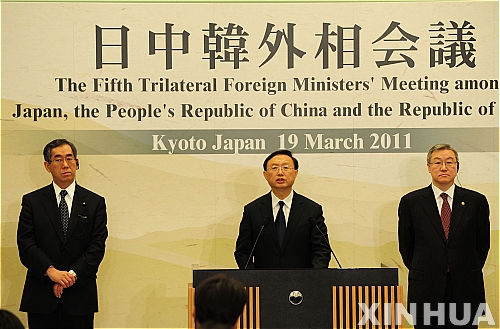
President Lee Myung Bak is visiting China for 3 days to participate in the 5th Korea, China, Japan trilateral summit.
The three countries, at the summit, agreed to start free-trade talks this year.
The three nations consist of the one-fifth of the world's total GDP, and one-sixth of world's trade volume. If the FTA is concluded, it will bring economic benefits to all three countries.
Also, the three voiced to urge North Korea to refrain from further provocations, and nuclear tests.
The three nation leaders agreed upon the need for a new measure to deter North Korea's threats, and affirmed that further provocations, and nuclear tests is intolerable.
Anyways we hope that the summit will be a base for the three countries' development and cooperation to a better world.
Sunday, May 13, 2012
S. Korea, China, Japan agree to launch free trade talks this year
.jpg)


South Korea, China and Japan agreed Sunday to launch official negotiations this year to forge an ambitious pact tearing down barriers to trade between the three of Asia's biggest economies.
South Korean President Lee Myung-bak, Chinese Premier Wen Jiabao and Japanese Prime Minister Yoshihiko Noda reached the agreement during annual summit talks in Beijing that also covered North Korea and other issues of cooperation.
The envisioned pact, if realized, would create one of the world's largest markets as South Korea, China and Japan account for 20 percent of the global gross domestic product (GDP), 17.5 percent of all global trade, and 22 percent of the global population.
Such a deal could also help improve overall relations between the three countries, which have often frayed over their shared history, including Japan's aggression against the other nations in the early 20th century.
But widespread views are that negotiations would be tough and lengthy.
"I believe the launch of FTA negotiations this year is very meaningful for the future of cooperation between the three countries," Lee said during a joint news conference after the summit talks.
During a meeting with business leader of the three countries, Lee also said that an FTA between the three neighbors could significantly contribute to the world economy and global free trade efforts.
On the sidelines of the summit, the three countries also signed an investment guarantee treaty that calls for providing most-favored-nation status and other protective measures for investment from each other.
The pact is the first economic treaty between the three countries.
North Korea was high on the agenda for the summit.
Sunday's talks came a month after Pyongyang's long-range rocket on April 13. Though the rocket fizzled soon after takeoff, the liftoff drew international condemnation as it broke a U.N. ban adopted over concerns such a launch could be used to develop missiles capable of carrying nuclear warheads.
Concerns have since grown that Pyongyang could stage additional provocations, such as a nuclear test, which would be its third, as well as more missile tests and border clashes. Officials in Seoul have said the North appears to have completed preparations for a nuclear test.
They exchanged views on the launch of North Korea's new leadership, its long-range rocket launch and related developments.
Lee also said he proposed during the summit that the three countries should cooperate closely to study "more effective" and fresh measures to deter North Korean provocations. Lee did not elaborate.
But Chinese Premier Wen spoke in a softer tone during the news conference, calling for all sides to "abandon Cold War-style thinking" so as to resolve tensions and stressing the "most urgent issue for now is to prevent tensions on the Korean Peninsula."
During the summit talks behind closed doors, however, Wen said that China has been strongly urging Pyongyang to refrain from additional provocations since last month's rocket launch, according to Kim Tae-hyo, a senior security aide to President Lee.
China is usually reluctant to openly criticize North Korea. Beijing is the North's last-remaining major ally that provides the isolated nation with crucial economic aid and diplomatic support. Experts say China dreads any instability in North Korea as it could hurt its economic and political interests.
The three countries also signed two other cooperation agreements, one of them on agricultural cooperation and the other on preventing desertification of forests and protecting wildlife.
Later in the day, Lee held one-on-one summits with Wen and Noda.
South Korea, China and Japan have held an annual three-way summit since 1999 on the sidelines of regional summits organized by the Association of Southeast Asian Nations (ASEAN). Since 2008, the sides have also held another regular summit that rotates among the three countries, and Sunday's meeting was the fifth.
Monday, April 9, 2012
NK nuclear test

Yesterday, I wrote a post about North Korean rocket launch.
On top of that news, North Korea is further adding to tensions, readying for a nuclear test.
Satellite
images show the communist nation digging a new tunnel underground in the Punggye-ri
nuclear test site in the country's northeast, where it conducted two previous
nuclear tests, first in 2006 and then in 2009, according to South Korean
officials.
The
construction is believed to be in its final stage, the official said.
Commercial
satellite imagery showed piles of earth and sand at the entrance of a tunnel in
the Punggye-ri site. The soil is believed to have been brought to the site to
plug the tunnel, one of final steps before carrying out a nuclear test blast.
South
Korean officials said they cannot rule out the possibility of North Korea
setting off a nuclear device built with highly enriched uranium this time,
unlike two previous tests where plutonium was used.
The
North's nuclear and missile programs have long been a regional security
concern. The country is believed to have advanced ballistic missile technology,
though it is still not clear whether it has mastered the technology to put a
nuclear warhead on a missile.
It’s
believed that NK will announce the nuclear test as a threat in response to
international criticism against the satellite launch and suspension of US food
aid.
Although
we do not know for sure if North Korea really has the technology, it might be
too risky to ignore the fact that North Korea might have WMDs with even the slightest
possibility. Because it might result in unimaginable consequences on the
national security of East Asian countries.
NK
regime must be rooted out, just the way Sadaam has been eliminated.
Wednesday, April 4, 2012
Economic Sanctions Against NK: Do we need more of it?

Economic sanctions are imposed against North Korea for four primary reasons:
(1) North Korea is seen as posing a threat to the security of East Asia
(2) North Korea is a state sponsor or supporter of international terrorism
(3) North Korea is a Marxist-Leninist state, with a Communist government
(4) North Korea has been found by the United State Department to have engaged in proliferation of weapons of mass destruction.
Moreover, the United States has also taken steps to isolate the Macau-based Banco Delta Asia for counterfeiting and money-laundering activities, actions North Korea has characterized as attacks against it.
In accordance with U.S. law, the United States limits some trade, denies trade in dual-use goods and services, limits foreign aid, and opposes entry into or support from international financial institutions.
Here' s one thing I learnt about NK in Game Theory class. Game theory can be applied to study actions (both political or economic) between 'rational' countries. However, rationality does not exist in NK, so it is very tough to study NK's actions. Not only do we have a very imperfect information about NK, making it a very complex Bayesian game, NK is simply very irrational.
So what do we do with irrational parties? Simply do not negotiate with them.
Negotiations with them is impossible. The only answer to irrationality would be economic/physical/political sanctions and threats.
The day of NK rocket launch is nearing. Kim Jong Un claims that the 'satellite' will be launched next week, around April 12-14.
Although the international society have been pressuring the NK regime into aborting the launch, I believe the sanctions on NK was insufficient to thwart their efforts.
What we need is stronger sanctions. Although it is very unfortunate that the North Korean people are starving, persuading them to abandon nuclear weapons for food is definitely not the answer to the problem. Although the food may ease the starvation problem for a temporary period, it will extend and justify the dictatorship in NK for a longer time, which will in turn backfire at the NK people for a extended period of cruelty from the totalitarian government.
Monday, April 2, 2012
Rocket to cost North equivalent of feeding 19 mil. for 1 year

This month's long-range rocket launch will cost North Korea some US$850 million, the equivalent of feeding 19 million people for one year, intelligence authorities in Seoul estimated Monday.
According to the estimate, revealed by a military official, construction of the launch site is expected to cost the North $400 million, while the rocket and its payload will cost $300 million and $150 million, respectively.
Source: Yonhap News Agency
Thursday, March 29, 2012
Foreign ministers of S. Korea, China, Japan to hold talks on N. Korea

Top diplomats from South Korea, China and Japan will hold three-way talks early next month on regional security and cooperation, Seoul's foreign ministry said Thursday, with North Korea's rocket plan expected to be a hot topic on the sidelines.
South Korean Foreign Minister Kim Sung-hwan will hold the two-day tripartite talks with China's Yang Jiechi and Japan's Koichiro Gemba in the eastern Chinese city of Ningbo starting April 7, ministry spokesman Cho Byung-jae said.
The three-way meeting, the sixth of its kind, comes as North Korea has defied international condemnation and pressed ahead with its plan to launch a satellite into orbit on the back of a long-range rocket sometime between April 12 and 16.
"It is certain that the issue (of North Korea's planned rocket launch) will be discussed bilaterally on the sidelines of the trilateral talks," Cho said.
Earlier on Thursday, Japan's Tokyo Shimbun reported that Pyongyang has started fueling a rocket for the planned launch, citing a source close to North Korea. Cho said he could not confirm the report, saying it is an intelligence matter.
South Korea, the United States and Japan have condemned the North's rocket plan as a disguised test of its improved international ballistic missile technology.
The North's maneuver also puts in jeopardy an aid-for-denuclearization deal Pyongyang signed with Washington in late February.
South Korean and Japanese military officials have said they would shoot down the rocket if it violates their airspace.
Pyongyang's missile program has long been a regional security concern, along with its nuclear programs. The country is believed to have advanced ballistic missile technology, though it is still not clear whether it has mastered the technology to put a nuclear warhead on a missile.
North Korea has carried out two nuclear tests, first in 2006 and then in 2009.
U.S. to rethink N. Korea policy in case of rocket launch: Pentagon official

The Obama administration will overhaul its approach toward North Korea if it presses ahead with a multiple-stage rocket launch next month, a senior Pentagon official said Thursday.
James Miller, nominated as undersecretary of defense for policy, made clear that the U.S. won't be able to fulfill what it agreed to do in a Feb. 29 aid-for-concession deal with North Korea.
"My view is that if North Korea goes forward with this test, we will stop this aid and stop the other steps that we had intended to take and have to have a complete reconsideration of where we go in the future," he said in a Senate confirmation hearing.
He is currently serving as principal deputy undersecretary of defense for policy. If confirmed, he will replace Michele Flournoy, who retired in February.
After high-level talks in Beijing in February, the U.S. said it would provide 240,000 metric tons of food aid to the North. It was an apparent reward for Pyongyang, which pledged to suspend some of its nuclear and long-range missile activities. The two sides also reportedly agreed to a set of social and cultural exchanges, including a concert by a North Korean orchestra in the U.S.
But the North abruptly announced a plan to launch a rocket that it claims is intended to put an observation satellite into orbit. The launch would take place April 12-16, the North said.
Miller confirmed that 240,000 tons of food aid is worth US$200 million.
He pointed out North Korea's missile and weapons of mass destruction programs pose a "direct and serious threat" to U.S. regional allies and parters.
The also have the "potential to become a direct threat to U.S. territory," he said.
He stressed, however, the need for continued efforts to resolve the North Korea issue diplomatically.
"I believe the United states must work with our allies and other key partners in the region and internationally on diplomatic solutions to the range of pressing concerns we face with North Korea," he said. "Under the appropriate conditions, direct diplomatic engagement with North Korea is important as well."
In a separate congressional hearing, meanwhile, Adm. Samuel Locklear, who heads the U.S. Pacific Command, said the North's rocket move is the "most pressing security situation."
"We will have to continue to be positioned to ensure security from those type of provocative events that the North Korean regime seems to be intent on pursuing," he told the members of the House Committee on Appropriations.
Testifying next to him, Gen. James Thurman, commander of the 28,500 U.S. troops in South Korea, said that the launch will unequivocally violate U.N. Security Council resolutions that ban it from using ballistic missile technology.
He added the North's new leader, Kim Jong-un, is following the "same patterns" of behavior of his late father, Kim Jong-il, and grandfather, Kim Il-sung.
"I do think he is being closely shepherded by his uncle, Kim Jong-il's brother-in-law, Jang Song-thaek," he said. Jang, granted four-star general rank recently, serves as vice chairman of the powerful National Defense Commission.
Tuesday, March 27, 2012
Leaders make fresh commitments toward safer world without nuclear terror
Global leaders made fresh commitments Tuesday toward building a safer world without nuclear terrorism, presenting pledged reductions of weapons-grade fissile material, either completed or under way, as evidence that the two-year-old Nuclear Security Summit process is working.

The two-day gathering in Seoul of leaders and high-level representatives from 53 countries and four major organizations around the world ended with a joint declaration, dubbed the "Seoul Communique."
"Nuclear terrorism continues to be one of the most challenging threats to international security," the communique said. "Defeating this threat requires strong national measures and international cooperation, given its potential global political, economic, social and psychological consequences."
The statement called for minimizing the use of weapons-usable, highly enriched uranium by the end of 2013 and set 2014 as a target date for putting into effect an amendment to the Convention for the Physical Protection of Nuclear Materials (CPPNM).
CPPNM is a key international pact that stipulates physical protection of nuclear materials during international transport, lays out a framework for cooperation in the protection, recovery, and return of stolen nuclear material and lists certain serious offenses involving nuclear material. A 2005 amendment, which includes protection for nuclear facilities, has yet to take effect.
The Seoul meeting is a follow-up to the inaugural summit hosted by Obama in Washington in 2010 when leaders focused on strengthening the security of fissile material worldwide and securing against nuclear terrorism.
In Seoul, world leaders, including Obama, Russian President Dmitry Medvedev and Chinese President Hu Jintao assessed accomplishments of commitments made in Washington and laid out more concrete actions to curb the threat of nuclear terrorism and illicit trafficking.


The two-day gathering in Seoul of leaders and high-level representatives from 53 countries and four major organizations around the world ended with a joint declaration, dubbed the "Seoul Communique."
"Nuclear terrorism continues to be one of the most challenging threats to international security," the communique said. "Defeating this threat requires strong national measures and international cooperation, given its potential global political, economic, social and psychological consequences."
The statement called for minimizing the use of weapons-usable, highly enriched uranium by the end of 2013 and set 2014 as a target date for putting into effect an amendment to the Convention for the Physical Protection of Nuclear Materials (CPPNM).
CPPNM is a key international pact that stipulates physical protection of nuclear materials during international transport, lays out a framework for cooperation in the protection, recovery, and return of stolen nuclear material and lists certain serious offenses involving nuclear material. A 2005 amendment, which includes protection for nuclear facilities, has yet to take effect.
The Seoul meeting is a follow-up to the inaugural summit hosted by Obama in Washington in 2010 when leaders focused on strengthening the security of fissile material worldwide and securing against nuclear terrorism.
In Seoul, world leaders, including Obama, Russian President Dmitry Medvedev and Chinese President Hu Jintao assessed accomplishments of commitments made in Washington and laid out more concrete actions to curb the threat of nuclear terrorism and illicit trafficking.

"During the Seoul summit ... new commitments were put forward that will reduce the threat of nuclear terrorism," host South Korean President Lee Myung-bak said during a news conference as chairman.
"I firmly believe these leader-level political consensuses will be embodied through international cooperation and domestic measures of each country," he said.
During the conference, Lee put forth cases of progress one after another that have been made since the Washington summit, including disposal of 480 kilograms of highly enriched uranium by eight countries, an amount enough for 19 nuclear weapons.
Ukraine and Mexico, in particular, accomplished a total "cleanout" of all stockpiles of highly enriched uranium just prior to the Seoul meeting by returning them to Russia and the United States, he said.
In addition, 3,000 nuclear weapons worth of highly enriched uranium has been downgraded to safer, low-enriched uranium in Russia and the U.S. The two nations are also working to implement an agreement that will result in the removal 68 tons of plutonium, enough for 17,000 nuclear weapons, he said.
Other cases of progress included Belgium, France, South Korea and the U.S. announcing a joint project on developing high-density low-enriched uranium fuel to replace highly enriched uranium in research reactors.
The Czech Republic, Mexico and Vietnam converted their research reactors using highly enriched uranium to low-enriched uranium, while Belgium, France, the Netherlands and the U.S. also announced a joint project to produce medical isotopes without the use of highly enriched uranium by 2015.
Noting Japan's nuclear disaster last year, the communique also called for "the nexus between nuclear security and nuclear safety."
"We consider that sustained efforts are required to address the issue of nuclear safety and security in a coherent manner that will help ensure the safe and secure peaceful uses of nuclear energy," it said.
In the aftermath of Japan's Fukushima nuclear disaster, calls have grown for the U.N. nuclear watchdog, the International Atomic Energy Agency (IAEA), to carry out more stringent inspections and for better cooperation and crisis management among nuclear regulators around the world.
The potential threat of nuclear terrorism was highlighted by the Fukushima disaster because it showcased the extent of potential damage if terrorists were to sabotage key systems of a nuclear power plant such as a power supply or cooling system, experts said.
The document reaffirmed the key role of the IAEA.
"We welcome the intent by the IAEA to continue to lead efforts to assist states" to effectively prevent nuclear terrorism and ensure the safety of atomic energy.
During the news conference, Lee said it will be difficult for North Korea to transfer nuclear material out of its borders if countries around the world follow through with measures discussed during the just-ended international conference on nuclear security.
"Unlike in the past, it will be difficult for North Korea" to transfer nuclear material beyond its borders "if an international monitoring system gets into operation," he told the conference.
Lee also said world leaders raised North Korea's planned rocket launch during the conference.
"Though it was discussed during bilateral summits, many leaders also raised the issue during the main meeting as well," Lee told the conference. "I think North Korea will be affected psychologically by these efforts to keep nuclear material from falling into the hands of dangerous people."
Lee stressed that the rocket launch is a "head-on challenge" to the international community.
Lee also said that not only the United States, but also Russia and even the "Chinese representative" pointed out during bilateral summits with him that the rocket launch is not desirable at a time when Pyongyang should care about improving the lives of its people.
A third summit will be held in the Netherlands in 2014.

Source: Yonhap News Agency
Korean Grilling on Glass, at Kristalbelli


Coming to Midtown before Christmas: Kristalbelli, Manhattan’s latest entry in the global quest to make Korean barbecue upscale, not just popular. Its chef, David Shim, has worked at Gramercy Tavern, L’Atelier de Joel Robuchon and Veritas. He promises Wagyu beef, organic vegetables, pork belly and the usual prize morsels for grilling.
But the main attraction will be the grills themselves. Each unit, set in the center of the table, is made of a single piece of crystal, with infrared heat that will produce higher temperatures than charcoal or gas grills. In Korea, both infrared and crystal cooking have been touted for their health benefits. Here, some backyard grill jockeys have experimented with infrared, but this will be a first for a restaurant. Powerful downdraft machines are promised to suck the usual smoke and cooking smells out through the floor.
This combination of sleek lounge and D.I.Y. grilling is the brainchild of the young Korean entertainment mogul J.Y. Park.
Monday, March 26, 2012
World leaders to endorse specific actions to counter nuclear terrorism


World leaders gathered for a second summit on nuclear security are poised to approve more specific plans and new pledges of action to prevent nuclear terrorism and ensure atomic safety, diplomats said Tuesday.
Top leaders from 53 nations and four international organizations, including U.S. President Barack Obama and Chinese President Hu Jintao, on Monday kicked off a two-day meeting dedicated to making the world a safer place without the threat of nuclear terrorism.
Sunday, March 25, 2012
S. Korea ready for nuke summit


Obama in S. Korea to attend nuke summit

S. Africa's Zuma visits S. Korea for nuke summit


Australian PM visits S. Korea for nuke summit

Belgian deputy PM visits S. Korea for nuke summit

Norway's Stoltenberg visits S. Korea for nuke summit

Armenia's Sargsyan visits S. Korea for nuke summit
World leaders are flocking to Seoul for a summit to prevent nuclear-armed terror, but tensions over North Korea's push to arm itself with nuclear weapons and long-range missiles is set to dominate the sidelines of the event, diplomats here said Sunday.
Leaders from 53 nations and four international organizations will convene Monday and Tuesday for the second Nuclear Security Summit, but North Korea's rocket launch planned for mid-April has overshadowed the global gathering.
U.S. President Barack Obama arrived in Seoul earlier Sunday and then visited the tense border with North Korea, calling the Demilitarized Zone (DMZ) "freedom's frontier."
"The contrast between South Korea and North Korea could not be clearer, could not be starker," Obama, who was wearing a dark windbreaker, told a group of American troops inside the DMZ, according to a pool report. About 28,500 U.S. troops are stationed in South Korea.
Obama launched the first nuclear security summit in Washington two years ago and the Seoul summit is aimed at working out more specific actions to prevent loose nuclear materials from falling into the hands of terrorists.
Nuclear issues on North Korea and Iran are not on the agenda for the summit, but Seoul officials have said that the North Korean nuclear issue can be discussed bilaterally on the margins of the summit.
Except North Korea, leaders of all member countries involved in the six-party talks on ending the North's nuclear drive will attend the Seoul summit. The multilateral talks, involving the two Koreas, the U.S., China, Japan and Russia, have been stalled since late 2008.
After a bilateral summit with South Korean President Lee Myung-bak in Seoul on Sunday, Obama warned that the North's provocative move will deepen its isolation, hurt relations with neighboring countries and harm the prospects of future negotiations.
The Lee-Obama meeting, the first since the death in December of North Korean leader Kim Jong-il, came amid heightened tension following the North's announcement of plans last week to launch a rocket in mid-April to put what it called a "working" satellite into orbit.
South Korea, Japan and the U.S. have defined the North's rocket launch plan as a disguised test of its improved long-range missile technology and warned that it would retaliate should the country go ahead with the plan.
The North's move also puts in jeopardy an aid-for-denuclearization deal it signed with the U.S. in late February, promising to suspend its uranium enrichment and allow in U.N. nuclear monitors in exchange for 240,000 tons of food aid.
In an interview with Yonhap News Agency on Friday, Gary Samore, the coordinator for arms control at the U.S. National Security Council, warned that North Korea will face a "strong response" from the U.S. and its allies if it goes ahead with the launch.
"We will be working with other countries, when President Obama is here, to try to discourage North Korea from going ahead with the proposed satellite launch," Samore said.
A principle achievement for the first nuclear security summit in Washington was gaining agreement by all 47 participating nations that nuclear terrorism is among the top global security challenges and that strong nuclear material security measures are the most effective way to prevent it.
The Seoul summit will serve as a "stepping stone" to translate the political will generated at the Washington summit into action, while laying a cornerstone for attaining key nuclear security goals in the mid and long-term, Seoul diplomats said.
Negotiators, or "sherpas" from the 53 participating nations for the Seoul summit, held their final meeting in Seoul on Friday and fixed the agenda for the Seoul summit and the text of the so-called "Seoul Communique" that will be announced at the end of the summit, said Hahn Choong-hee, a spokesman for the summit.
On the sidelines of the two-day summit, President Lee will also hold a series of bilateral summit meetings with China's Hu Jintao and Russia's Dmitry Medvedev to discuss the issue of the North's planned rocket launch.
Obama and Hu are also scheduled to hold a bilateral summit during the nuclear security conference.
On the eve of the largest summit hosted by South Korea, more than 20 heads of state, including Chinese President Hu and U.N. Secretary-General Ban Ki-moon, arrived in Seoul.
Before the summit begins on Monday afternoon, leaders from 23 nations, including Japanese Prime Minister Yoshihiko Noda, will touch down in the South Korean capital, organizers said.
During the summit, Noda will tell about the lessons his government has learned from the Fukushima nuclear disaster. The summit's main agenda includes ensuring atomic safety.
A powerful earthquake and an ensuing tsunami devastated Japan's Northeastern region last March, killing some 20,000 people. It destroyed the Fukushima nuclear power plants, causing environmental havoc to the area.
The accident, classified as the worst nuclear calamity since the 1986 Chernobyl disaster, prompted countries with nuclear power plants to further review the safety of their atomic energy.
Media attention is high. Organizers said more than 3,000 journalists from around the world have been registered.
Security is tight at the summit's venue in southern Seoul, the Convention and Exhibition Center (COEX).
Police have raised the nation's terror alert to the highest level, "severe," ahead of the summit.
Tens of thousands of police officers have been dispatched to COEX as well as airports, foreign consulates and hotels where nuclear summit leaders will stay during the summit. Police officials have been placed on emergency standby in every subway station in the capital.
Seoul officials said that the Netherlands has agreed to host the third Nuclear Security Summit in 2014. At the Seoul summit, South Korea will likely formally name the Netherlands as the host for the next summit.
Source: Yonhap News Agency
Obama to have broader diplomatic issues in mind during DMZ trek


Staring at North Korea through binoculars at the heavily fortified land border with South Korea, U.S. President Barack Obama will attempt to send a message not only to Pyongyang but also to Teheran, another recalcitrant regime in the eyes of western officials, a U.S. newspaper said Saturday.
Obama's trip to the Demilitarized Zone (DMZ), which former President Bill Clinton called "the scariest place on Earth" during his own visit, is apparently aimed at boosting his image as the "sole commander-in-chief" of the U.S., beset with a host of thorny diplomatic issues, including North Korea, Afghanistan, Syria and Iran, according to Politico.
Source: Yonhap News Agency
Wednesday, March 21, 2012
President Obama may visit Korean DMZ


In a special commencement this month, it was announced that President Barack Obama is due to visit the demilitarized zone on South Korea‘s border with the North on Sunday before a nuclear summit in Seoul.
The United States president’s trip to the area separating the north and south on the Korean peninsula comes amidst increased tension over Pyongyang‘s plan to launch a rocket next month. His visit will be a show of support for South Korea, said the White House. There are currently about 28,500 US soldiers stationed in the area.
The 2.5-mile-wide DMZ is the most heavily guarded border area in the world. Former US President Bill Clinton described it as ’‘the scariest place on earth’‘ when he visited in the 1990s. Obama, who is expected to renew pressure on Pyongyang to abandon its nuclear ambitions, will also meet South Korea’s President Lee Myung-bak ahead of the summit starting on Monday.
The three-day Nuclear Security Summit involves more than 53 leaders from nations and international organizations. Obama is also due to meet Chinese President Hu Jintao and is widely expected to urge him to draw on Beijing‘s influence for nuclear negotiations with Pyongyang.
Thursday, March 15, 2012
Is the Army to blame for the Afghan massacre?


The soldier accused of gunning down 16 Afghan civilians could face the death penalty if convicted. Should his superiors be held accountable, too?
The U.S. military is facing "unprecedented strains" in Afghanistan in the wake of Sunday's massacre of 17 Afghan villagers, including 9 children, allegedly at the hands of a disturbed American soldier who was on his fourth tour of duty in a decade and had previously suffered a traumatic brain injury. Afghan President Hamid Karzai has demanded that NATO pull all foreign troops out of outposts in remote villages, and return them to their bases. The Obama administration is promising justice, and the military might bring capital murder charges against the unnamed suspect. But even if he's found guilty, and acted alone, do his superiors share some of the blame for deploying a damaged, war-weary soldier?
Blame the generals: "If the allegations prove true," nothing can absolve the soldier" of his responsibility for this "cold blooded murder," says Jim Frederick at TIME. But military commanders have to answer for this "atrocity," too. If the soldier's superiors missed "red flags" — the traumatic brain injury that the soldier suffered in Iraq might have affected his behavior — they must be held accountable if we're to have any chance of preventing the next tragedy.
"Is the Army responsible for the Afghan massacre?
Blame the politicians: "Perhaps the Army could have done more," says Robert H. Scales in The Washington Post. But second-guessing the people on the front lines is unfair. The "real institutional culprit" is our leadership in Washington, which has cynically overused "one of our most precious and irreplaceable national assets: Our close-combat soldiers and Marines." Asking our troops to face 10 years of battlefield stress may have made this kind of tragedy inevitable.
"Afghan massacre — who to blame"
It's unfair to blame anyone: Vietnam showed us that "something like this" was bound to happen some day, says USA Today in an editorial. "People crack, and they kill" — and the danger they pose is "obvious only in hindsight." It's natural to lay blame, but it's often unfair. These things happens in war, and they happen at home. The Afghan slaughter was probably "no more preventable than last month's shooting of five Ohio high school students by a classmate."
Wednesday, March 14, 2012
S. Korea-U.S FTA takes effect, sets new era for bilateral ties


The free trade pact between South Korea and the United States came into effect on Thursday, ushering in a new era of expanded economic and political ties between the two allies.
The free trade accord, signed in 2007 and ratified by lawmakers in both countries, is one of the most ambitious deals that South Korea has ever finalized.
The U.S. is the second-largest trading partner for South Korea after China. Last year, trade between South Korea and the U.S. totaled US$108 billion. South Korea's exports to the world's largest economy reached $56.2 billion last year, with Asia's fourth-largest economy importing $52.1 billion worth of goods.
Experts said that the free trade deal will pave the way for South Korean companies to tap deeper into the world's biggest economic entity.
Overall, the free trade pact, known as the KORUS FTA, will help South Korea's economy expand by more than 5 percent in the long term as it will lead to more exports by reducing trade barriers, a study showed. The deal will create about 350,000 jobs, helping ease tightened labor market conditions here.
The report compiled by 10 local think tanks predicted that South Korea will see its trade surplus with the U.S. increase by $140 million annually over the next 15 years after the FTA goes into effect. The nation's total global trade surplus, however, will expand by an annual average of $2.77 billion, the report showed.
"The free trade pact with the U.S. will help South Korean firms secure a firm footing in the world's largest economy as well as help deepen the economic alliance in addition to the existing military and security alliance," the ministry said in a statement.
Under the deal, Seoul and Washington would eliminate or phase out tariffs on 85.7 percent of U.S. goods and 87.3 percent of South Korean goods in three years after the accord takes effect. They have also agreed to abolish tariffs on most industrial goods within five years of the deal taking effect.
One of the most sensitive issues was auto trade.
Under the terms revised in 2010, the two countries agreed to scale back tariff cuts for cars.
The U.S. will eliminate its 2.5 percent tariff on automobiles in four years, instead of immediately or after three years, as was previously agreed, after the deal takes effect.
South Korea will cut its 8 percent tariff on U.S. car imports to 4 percent immediately, instead of immediately eliminating it.
The free trade pact with the U.S. is the eighth of its kind that South Korea has sealed.
Currently, South Korea has free trade agreements with Chile and Singapore as well as similar pacts with the Association of Southeast Asian Nations and India.
South Korea and the European Union (EU) also implemented their free trade deal in July last year.
The country is actively seeking similar pacts with China, Canada, Turkey and Colombia, among several other countries.
Subscribe to:
Posts (Atom)