Showing posts with label Food/Drinks. Show all posts

Monday, September 24, 2012

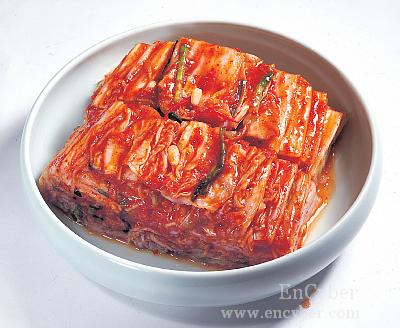
Tried Kimchi with Rice


I recently read an article from Washington Post, 'Kimchi : Korea's affordable health care' where it reveals the health effects of Kimchi, one of the world's 5 healthy food. In Japan, Kimchi is already popular in normal households. I had the opportunity to eat Kimchi a couple of times when I went to a Korean restaurant. It wasn't as spicy as I expected, and although it was kind of sour, vinegarish tasting, it was pretty good. It had the unique neat taste of Korean food. Kimchi is abundant in lactic acid, and dietary fibers, which helps anti-aging, digestion, strengthens immune systems, and cleans out the toxic waste within the body. With all this health benefits with the taste... Why don't you give it a try!
http://www.washingtonpost.com/lifestyle/food/kimchi-koreas-affordable-health-care/2012/09/17/ecb7614e-003b-11e2-b257-e1c2b3548a4a_story.html

Wednesday, August 1, 2012

K-Food, Anyone??


Are you tired of what you eat everyday? Do you want to spice things up at your dining table?
If you got tired of Chinese and Japanese cuisine, give Korean cuisine a try!
Korean food is not greasy, and is vegetarian-based well-being cuisine.
K-food may be too spicy for your taste, and Kimchi may be weird at first, but it is a taste that people get addicted to when they get used to it. So it would be foolish to keep K-food off you menu.
Are you in by any chance in Britain? If so, then you are in luck.
At London, where the Olympics is being held, there is an opportunity to try out Korean cuisine.
The UK's largest retail firm, Tesco New Malden store, will feature a Korean cuisine section.
Once you get the hang of it, you will get hooked and mesmerized by Korean cuisine!

Thursday, July 26, 2012

Fermented Hong-eo, an experience worth trying


One of the most difficult dishes to get used to in Korean cuisine for foreigners and even locals alike is fermented skate, or Hong-eo. Some even say that Swedish fermented herring, also notorious for its distinctive, fermented taste, is nothing compared to  Korea’s fermented skate.

The verdict is in, the hong-eo experience warrants a hung jury. 
At first I thought it made no sense to eat hong-eo (fermented skate fish), a food that smells like ammonia because its uric acid has to pass through and is ultimately stored in its flesh. 
The dish in Korean is called hongeo samhap. Hongeo means skate and samhap translates as “harmonious trinity,” referring to the three elements of the dish – fermented skate, boiled pork belly and kimchi. In Korea, for around 40,000~50,000 won, a large collection of samhap is offered.

The fermented skate at first has a foul odor that is similar to the smell of ammonia, but many Koreans say that after a while the taste of this fermented fish is addictive.
Eaten alone, raw hong-eo is repugnant, yet the triple-decker, bite-sized samhap is rather tasty; it is strangely addictive...

While the pork fat provides a bit of sweetness, Kimchi, another fermented food, neutralizes hong-eo’s magical properties. Selective parts can be dipped into a dried red pepper and salt mix.


Here are some historic facts behind Hong-eo :

The dish is said to originate from Heuksan Island in South Jeolla, where fishermen discovered the main ingredient in hongeo samhap by accident.
Heuksan Island is famous for its high-quality skate fish. During the Joseon Dynasty, the skate from Heuksan Island was often brought to other parts of the country by boat. During this process, the fishermen discovered that even after a long journey, skate was still edible and that the fermentation that took place gave the meat a great, chewy texture and a slightly stinging sensation in your mouth.
The boiled pork belly and kimchi was originally served with the fish due to the fact that the skate was costly and rare. However, food experts now say that the three ingredients are extremely complimentary, as the pork gives a heartiness to the dish while the kimchi mitigates the grease from the pork as well as accentuating the fermented taste of the skate.
During the Joseon Dynasty, hongeo samtak (the same dish but including alcohol) was a favorite dish for parties and get-togethers and was served alongside makgeolli, or Korean rice wine. The dish is still eaten most with makgeolli, which also aids in diluting the rather pungent taste of the fermented skate.


Source : Hongeo: Not for the weak of stomach


So the final question must be asked, should you try it? 
Answer: At least once. 


And for those interested, here's a video from Youtube about Hong-eo


"This is one of those foods that you can't understand how it tastes unless you actually eat it."


Skip to 3:15 to watch Andrew trying to keep it down here:


Wednesday, July 18, 2012

It's hot, and I crave Patbingsu


I was surfing through the net (Yahoo! News) and read this article...

How Bad Is the US Drought? (Source : http://news.yahoo.com/bad-us-drought-040658131.html?_esi=1)
And yeah, if you read the article...
This year, it's extremely HOT... :(
Source : Yahoo! News Article
Look at all the red regions...
While looking at the photo, patbingsu came up on my mind, and I started craving it all day.
So, I decided to do a post about patbingsu.


Patbingsu (팥빙수) is just one of many red-bean based desserts in Korea. Pat (팥) is red azuki bean, boiled and sweetened to make a paste which is then layered atop bingsu, (빙수) or shaved ice. The ice itself is sweetened with condensed milk and makes for a lighter tasting treat than those ice cream sandwiches you've wolfed down in summers past. Topped with some rice cake, or ddeok (떡), for texture, this treat will cool and refresh.


Much like iced coffee confections, bingsu variations abound. Nokcha (녹 차, green tea), coffee and fruit variations are the most popular, and perfect for those who aren’t keen on red bean or rice cake. Bingsu topped with frosted cereal and fruit is often served as a side dish in hofs and noraebangs, perfect for re-hydrating sun-parched bodies and for thinning the alcohol coursing through soju-lined veins. Like most Korean dishes, bingsu's made to share, so grab your besties and scoop up a bowl of bingsu, available at most bakeries, major restaurants, and cafes for 3,000 to 8,000 won. It would be a shame to leave Korea without trying the dessert that most of your students will list among their favorites!


And here's the recipe I found online
(Source : http://www.maangchi.com/recipe/patbingsu)


Recipe - Traditional Patbingsu


Source : Maangchi.com


Ingredients:
Red beans (azuki beans), sugar, vanilla, salt, shaved ice, sweetened condensed milk, rice cake, strawberries, banana, and kiwi.


Directions for 4 servings:


Preparation: Making sweet red beans:


Rinse and strain 1 cup of red beans and place them in a thick-bottomed pot.


Directions:


1 cup of dried red beans will make a little more than 2 cups of sweet red beans. Each serving of patbingsu needs ½ cup of sweet red beans.
Add 4 cups of water. Cover the pot and bring to a boil over low heat for 10 minutes.
Lower the heat to simmer for 1 hour.
Open the lid and check if the beans are cooked well or not. The beans should be crushed easily.
Chew a sample of the beans. If there is something hard when you chew, you need to cook longer.
Drain the water and add 1 cup of sugar, 1 ts vanilla, and ½ ts salt. Mix well. *tip: the water from the beans can be used for making rice
Uncover and stir the sweet beans over low heat for 5 minutes.
Turn the heat off and let it cool down. Keep in the fridge.
Putting it together:


Add ½ cup of sweet red beans on the bottom of a dessert bowl.
Add 1½ cups of shaved ice over the sweet red beans.
Add chopped strawberries, banana, and kiwi on top of the ice.
Pour 2 tbs of sweetened condensed milk onto red beans and place 5-7 chopped rice cakes on top.
Serve right away with a spoon and enjoy!


 This recipe and more can be found at the Maangchi cooking site here.

Wednesday, June 13, 2012

Korean Food Festival


Patrons can enjoy tasty Korean dishes and at the same time stand a chance to win two tickets to South Korea. FOR those who love Korean cuisine, catch the Korean Food Fair 2012 at Isetan outlets. Isetan of Japan Sdn Bhd invites  patrons to sample the exotic  tastes of Korean food, beverages and snacks at its supermarkets in Suria KLCC, Lot 10 and One Utama shopping mall.
The event is jointly organised by Isetan of Japan Sdn Bhd, KMT Trading Sdn Bhd and Korea National Tourism Organisation. As you enter the supermarket, you will be warmly greeted by a group of pretty ladies  in colourful hanbok,  a Korean traditional dress. You will hear them say anyong haseyo (hello) as you step in and kamsa hamnida (thank you) as you leave.


Patrons stand  a chance to win two tickets to South Korea when they spend more than RM100 in a single receipt. Isetan of Japan Sdn Bhd managing director Nobuharu Tutani said, "This marked the 15th year of the event and we are proud to once again share the exotic Korean fare with Malaysians." "This year's promotion is special as we have six Korean chefs joining us to showcase their authentic dishes.
"On top of that, the market also features a famous Korean modern restaurant called School Food." said Tutani. School Food, he said, serves an array of traditional  Korean cuisine including mari kimbab, jigae ramen, topokki, soup and other delicious dishes. KMT Trading Sdn Bhd managing director Matthew Lee said: "Over the past decade, we have been the provider of quality Korean food and beverage products in Malaysia.
"This year, we are expecting about 80,000 visitors in this 12-day event," Lee said after the launch of the food fair at Isetan KLCC recently. Other kiosks available are Anbokja which offers handmade traditional Korean snacks and Cheung Nyeon Uh-Mook, offering a variety of ondane (fish cakes). The main highlight at the Anbokja is the popular rice snack called gangjeong. It is a sweet and hollow puff made from glutinous, rice flour and coated in honey, roasted peanuts, almond, pumpkin seed and raisin.
Other snacks available here are brown shimeji mushroom, mini king's oyster mushroom and golden enoki mushroom. The Cheung Nyeon Uh-Mook kiosk offers "live-kitchen" concept where the chef is ever ready to prepare the guests' orders on the spot, so that the fish cakes are freshly served. Among the items in the menu are delicious hawker food like  crab uh-mook, cheese uh-mook, kimchi uh-mook, vegetable uh-mook and king sausage uh-mook. Other fresh food that customers can look forward to are poggy kimchi, seasoned green pepper and seasoned cuttlefish slice.
Another not to be missed dish is Korean ais kacang called patbingsu. Slightly similar to Malaysian dessert air batu campur, it is an ice-blended drink with a mixture  of rice cake, red bean, fruit cocktail and jelly with chocolate, strawberry and milk syrups. Dozens of Korean-made products that will be featured throughout the event are fresh ginseng, which is the best choice in preparing samgyetang (ginseng chicken soup); organic pure green tea, mukkoli (Korean rice wine) and Korean  instant noodle nong shim shin ramyun, among others.
Also present at the launch were the  Korean Embassy first secretary and consul Jo Won Gab,  second secretary Chung Chi Won, Tourism Malaysia to Minister of Tourism and Korea adviser Lee Jin Bok and Korea National Tourism Organisation managing director Yun Jae Jin. The Korean Food Festival 2012 ends on June 12.

Thursday, June 7, 2012

Makguli


Sommelier, Kikajakeshi, Master blender...
They are experts in wine, sake and whisky and they usually suggest alcoholic drink with suitable dishes. Kikajakeshi suggest taste and scent of Japanese traditional alcohol sake while there are Makguli sommelier who recommend Korean traditional alcohol Makguli according to consumer's taste.
The alcohol proof is between 6 to 9 degrees and it is full of dietary fiber and lactic acid bacteria.. Makguli is now becoming famous as it is known to be nutritious just like wine.
Makguli sommelier are interested in Korean food and try to recommend Makguli and suitable dishes to foreigners who try Makguli for the first time.
If you enjoy and love drinking, it would be nice to try Makguli and dishes recommended by Makguli sommelier when you visit Korea!
 

Monday, May 28, 2012

Kimchi, popular at International School of Beijing..!


Apparently, world famous well-being fermented food, Kimchi is once again gaining attention at Beijing.
 
Last week, Kimchi festival ended in success at the International School of Beijing's spring fair, where foreigners along with many Chinese participated.
 
The people and students who participated in the festival were captivated by the profound and mysterious spicy and fresh taste of Kimchi.
We once again hope for Kimchi to become a world-wide well-being food.
 

Sunday, May 6, 2012

Well-being Makgeolli Ad appears at Times Square


After last year's Bibimbop ad and Dokdo ad featured at Times Square, a Well-being Makgeolli ad appeared on the electronic display at Times Square and is garnering a lot of attention.
 Makgeolli is promoted as a "tasty, healthy, massively popular traditional Korean alocoholic beverage made from rice that will give you an amazing time".
 A product of natural fermentation, Makgeolli is packed with fiber, nutrients and health-friendly minerals that have multiple health benefits and is scientifically proven to prevent obesity and act as antioxidents and antiflammatory agents.
 Korean's traditional wine Makgeolli..
You can easily find it at your local store.
If you want to have a taste of Korea, why don't you give Makgeolli a try.
 

Monday, April 2, 2012

Korean food reception in Paris


Hur Kyung-wook, the South Korean Ambassador to the Organization for Economic Cooperation and Development (OECD), speaks during a reception in Paris on April 2, 2012, to tourism officials from 40 countries and foreign representatives to the OCED. The South Korean delegation and the state-run Korea Foundation hosted the reception to promote traditional Korean cuisine, known as "hansik."

Tuesday, March 27, 2012

Korean Grilling on Glass, at Kristalbelli


Coming to Midtown before Christmas: Kristalbelli, Manhattan’s latest entry in the global quest to make Korean barbecue upscale, not just popular. Its chef, David Shim, has worked at Gramercy Tavern, L’Atelier de Joel Robuchon and Veritas. He promises Wagyu beef, organic vegetables, pork belly and the usual prize morsels for grilling.
But the main attraction will be the grills themselves. Each unit, set in the center of the table, is made of a single piece of crystal, with infrared heat that will produce higher temperatures than charcoal or gas grills. In Korea, both infrared and crystal cooking have been touted for their health benefits. Here, some backyard grill jockeys have experimented with infrared, but this will be a first for a restaurant. Powerful downdraft machines are promised to suck the usual smoke and cooking smells out through the floor.
This combination of sleek lounge and D.I.Y. grilling is the brainchild of the young Korean entertainment mogul J.Y. Park.

Monday, March 12, 2012

'K-food' to be next big thing in Korean wave


The nation’s top agricultural bureaucrat expects that the next big thing in the Korean wave, dubbed hallyu, could be Korean food, or “K-food,” which he says will follow K-pop in chalking up global popularity. 
Minister for Agriculture, Forestry, Fisheries and Food Suh Kyu-yong projected during a recent interview with The Korea Times that 10 years should be enough for Korean cuisine to receive worldwide recognition. 


Watch the MV of K-Food Party by Wondergirls, the Ambassador of Korean Agriculture Food Export:
http://www.youtube.com/watch?v=BQg8SdQ1dHo


Source: 'K-food' to be next big thing in Korean wave

Monday, March 5, 2012

The Korean Restaurant that ranked 8th in "101 Best Restaurants in America for 2012"


Have you ever been to New York-based Korean-fusion restaurant Momofuku Ssam Bar?
This restaurant was ranked 8th by New York Magazine's "101 Best Restaurants in America for 2012."
Momofuku Ssam Bar is a casual, loud restaurant with an inventive menu that is constantly changing. The restaurant bases its menu on 'Ssam.' Their most popular menus are Bossam based meals like the 'Steamed Pork Buns,' which uses Chinese bread, hoisin, cucumber pickle, scallions, unsaturated prok bacon, etc. as ingredients, and 'Cream Tofu' that uses tapioca and sea urchin eggs.


For those of you who do not know what Bossam is, Bossam is a type of ssam in Korean cuisine in which steamed pork is wrapped in a leaf vegetable such as red lettuce or sesame leaf, often accompanied by a condiment known as ssamjang. It is usually topped with raw or cooked garlic, onion, pepper, or most commonly, sweet kimchi. Bossam is a popular dish in Korea.
Anyways, as 'Momofuku Ssam' is gaining recognition, the number of people who enjoy the Korean cuisine of ssam is increasing. From what I hear, Momofuku is a must if you are in town.

Thursday, February 23, 2012

Korean Beer


For those of you who don't know yet, Koreans usually drink soju, but beer is also a popular drink in Korea, often a substitute to those who don't like soju, and a complement to soju when making so-maek (soju+beer).


As a freshman at uni studying economics, drinking soju is the cheapest and fastest way to get drunk, thereby making it the most efficient choice. However, that was when I wasn't working my ass off. When my wallet was no more deprived of money after starting various part-time jobs, I changed my alcohol consumption from soju to beer. What I found disturbing about beer is that  Korean beer all taste really bland. The other beer options are overpriced foreign beers, which goes over my usual budget. Some of my friends say that Korean beer is sparkling water with little bit of alcohol added to it...


Koreans have few choices in beer even though they drink more of it than any alcohol beverage year after year. At any supermarket, convenience store, restaurant, food stall or bar, virtually everywhere, consumers have just two options: cheap and mediocre-tasting local beers or pricey imports.


What makes it sad is that people have come to accept this dichotomy as unavoidable, and adjust their consumption patterns to either downing Korean beer served in over-sized pitchers or splurging on fancy bottled foreign alternatives on special occasions. But the situation could change if the relevant regulations were liberalized ― cracking the OB-Jinro Hite duopoly. Local beers suffer not from lack of imagination but from lack of competition.

Wednesday, November 30, 2011

CNNgo's 40 Essential Korean Food

Pajeon. I don't know what the official English name for this is, but I call it Korean pancake.
Another CNNgo article. CNNgo has featured "40 Korean foods we can't live without". It is a list of 40 popular Korean foods this writer picked. Certainly not the best list of good Korean food, but it is nevertheless a good read for anyone who wants to know more about Korean food. Take a look :

40 Korean foods we can't live without

Wednesday, October 12, 2011

CNNgo : 20 delish Korean drinks!

yesss!
It's been a while since I posted a CNNgo article... so here it goes!

CNNgo has posted a list of 20 Korean drinks that you should know about. These range from alcoholic drinks like soju to banana milk - my personal favorite - and all the healthy drinks as well. Worth checking it out!

CNNgo - 20 delicious Korean drinks

Tuesday, October 11, 2011

Make Korean food and win a free trip to S. Korea!

Do you like Korean food? Do you like making it? Do you have your own special recipe?

Visitseoul.net, basically an official tour website for Seoul, is hosting this event called "Delicious SEOUL Story". You post your own Korean food recipe via Youtube, and the final 5 teams will be granted a free 4-day trip to Seoul. Last day to submit your recipe is Oct 31st, so get on it!

More information in English here : Delicious SEOUL Story

Monday, June 20, 2011

Korean Street Food - Pojangmacha (포장마차)

A typical street food scene in Korea
Pojangmacha [포장마차] (literally meaning covered wagon) is the central hub of street food culture of Korea. Go out to any busy city street at night (in Korea, of course). In every corner of the street, you'll see a pojangmacha. Says wikipedia :

Pojangmacha refers to small tented restaurants on wheels, or street stalls in South Korea which sell a variety of popular street foods such as hotteok, tteokbokki, sundae, odeng, and anju (dishes accompanied with drinking). It literally means "covered wagon" in Korean.[1] They are largely divided into two kinds-- one for snacks during the daytime and the other for drinking during the nighttime. The latter most commonly serves soju and anju more appropriate when consuming this alcoholic beverage.
Pojangmacha is a popular place to have a snack or drink late into the night. The food sold in these places can usually be eaten quickly while standing or taken away. Some offer cheap chairs or benches for customers to sit, especially the ones serving late night customers who come to drink soju.

Wednesday, June 15, 2011

Awesome Soju commercials - I'm a Singer style

Jyung-Yup(Left), YDH(Middle left), Kim Gun-mo(Right)
A few members of I am a Singer (나는가수다), a musical competition TV program for Korea's top musicians that is becoming more and more immensely popular right now, are putting together a series of Soju commercials for Cham-e-seul. They're actually ridiculously well-done and high-quality.

Basically they're all same songs, just sang and played with their own style. Below is the lyric.

Let's have one more Cham-e-seul~ I'll take you home~ Tell them you're gonna be late~
Do I look like a wolf to you for wanting one more shot of Cham-e-seul?
This night of Cham-e-seul I had with you shall be eternal
I am just too embarrassed to talk soberly
Let's down a shot of Cham-e-seul and we'll go out
Hey, I haven't said this to a girl before
Cham-e-seul really is a heart-opener
Let's have one more shot of Cham-e-seul, it's fresh and clear, like your eyes
One shot of Cham-e-seul, two shots of Cham-e-seul, your heart will open
I'll take you home, don't worry, tell them you're gonna be late
Look at my glass, it's empty! Fill her up with Cham-e-seul~

I know, it's a rather cheesy lyric, but just watch the videos below and you'll enjoy them.

Wednesday, June 1, 2011

Korean Drinking : Soju bomb / Korean 'bomb' drinks

Ready...
One of the many popular ways of drinking alcohol in Korea is obviously, dropping a drink in another. Think Irish car bomb, Jager bomb, Sake bomb... etc etc.

It is called Bomb(폭탄) Drink(주) = Bomb drink, 폭탄주. There are generally two ways to do this.

1. Soju + Beer
2. Western liquor (usually whiskey) + Beer


       More after the jump.


Wednesday, May 25, 2011

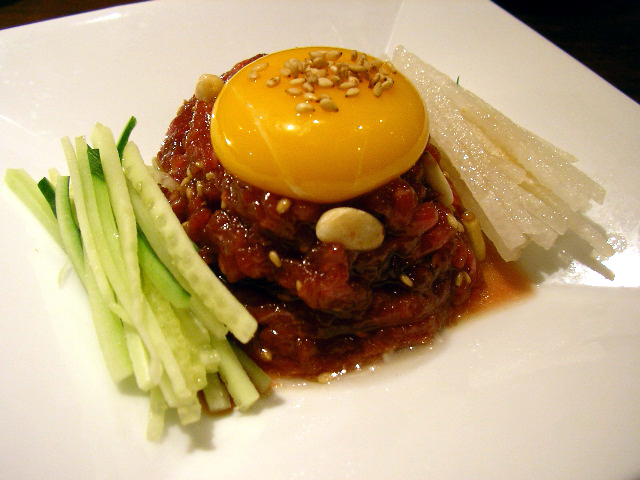
Korean food : Korean Steak Tartare - Yukhoe (육회)

Another food entry. This time, it's Yukhoe[yook-hwe], Korean steak tartare. Yukhoe directly translates to meat(yuk) sashimi(hoe). Yes, it's marinated raw steak meat. It's chewy, meaty... and... uh, I think Yukhoe is one of those things you just need to try it out first.

Source : Wikipedia
 And you might have guessed... it's great with Soju. I think it's a prerequisite for all Korean food. Yukhoe is actually another very popular Anju for Soju. More after.