Showing posts with label Economy. Show all posts
Showing posts with label Economy. Show all posts
Thursday, July 5, 2012
Korea joins the 20-50 club, and its implications on becoming a 30-50 club country
As of June 23, 2012, Korea's population hit the landmark figure of 50 million, according to Statistics Korea. The population increase is significant in that Korea became the seventh country with a population of over 50 million and per capita income exceeding US$20,000, following Japan, the US, France, Italy, Germany and the UK. Vice Minister of Strategy and Finance Shin Je-Yoon said that Korea has now succeeded in achieving both quantitative economic expansion and qualitative improvement.
Besides Korea, all the other countries have increased in the meantime their per capita to over USD 30’000. This is a signal that a large population is a central factor for a sustainable economic growth. There are several factors behind Korea’s impressive growth in the last two decades. The 1997 Asian financial crisis has become in fact a tremendous chance for Korea and its response to it has been the opportunity that has brought the country to its impressive economic achievement today. Korea managed to shift from an investment driven, technology intensive country to an innovation driven country, based on high-technology innovation in the late 90s and knowledge-based county in the late 2000s.
However, there is no time for complacency. Korea's population surpassed 40 million in 1983, and since then, has expanded by 10 million in the past 29 years. Statistics Korea forecast that the number will further increase to peak at 52.16 million in 2030. However, driven by the country's low birthrate, it is expected to fall back below 50 million in 2045 and further decline to 30 million in 2091.
Korea's birth rate is one of the lowest in the world. After falling below the replacement-level 2.1 for the first time in history in 1983, the rate slid to mark 1.23 in 2010. A nation can maintain the current population level only when a woman of childbearing age gives birth to 2.1 children or more during her lifetime. The falling birthrate is attributable to an increasing number of women in their 20s and 30s who participate in economic activities and delay or forgo marriage. It is estimated that the birth rate will reach 1.42 in 2040, slightly up from 1.23 in 2010. However, experts claim that the figure is too low to prevent a population decline.
Furthermore, Korea is struggling with its rapid population aging. In its recent report, the Royal Bank of Scotland announced that Korea has the world's fastest aging population. The median age for Korea jumped from 21.8 in 1980 to 37.9 in 2010. The nation's statistical agency predicted that it will further increase to 48.5 in 2030 and mark 52.6 in 2040. It is expected that Korea will become the most aged country in the world in 2040 along with Japan and Germany whose median age will reach 52.6 and 50, respectively.
Based on the falling birthrate and rapid population aging, the economically active population aged 15-64 is also dwindling at a fast pace. According to the prediction, the number of Koreans aged 15-64, which stood at 35.98 million as of 2010, will fall to 28.87 in 2040, dropping more than 7 million. Accordingly, the ratio of the number of senior citizens aged over 65 to 100 economically active people aged between 15 and 65 is on the rise. In 1980, the ratio stood at 6.1 but more than doubled to 15.2 in 2010. It will continue to move up to 22.1 in 2020 and record a whopping 57.2 in 2040.
Korea's economically active population is estimated to decline after reaching its peak in 2016. Under the circumstances, the government should work strenuously to boost the birth rate. It could also learn from the concept of 'active ageing,' which was developed by the European Commission. In the meantime, the government will thoroughly examine what implications the 50-million population suggests to the country and build up strategies to overcome challenges ahead.
We hope Korea can overcome the imminent challenges it faces right now, and does not put an end to the positive legacy of "all countries that reached the 20-50 club one day becomes a 30-50 club."


Wednesday, May 16, 2012
Hopes for a successful Korea, China, Japan, trilateral summit!
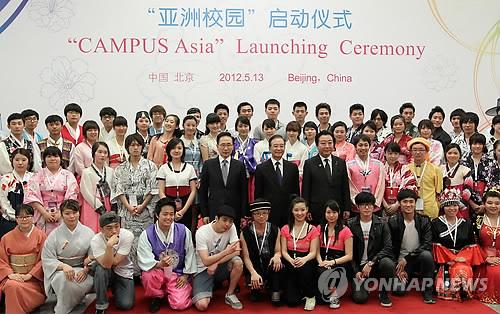
On the 13th and 14th in Beijing, Korea, China, Japan trilateral summit is being held to enhance cooperation in a variety of areas including security, business, and trade.
Over the past years, China has been took side with North Korea, but if there are further provocations or nuclear tests, China will no longer shelter North Korea and implement strict measures.

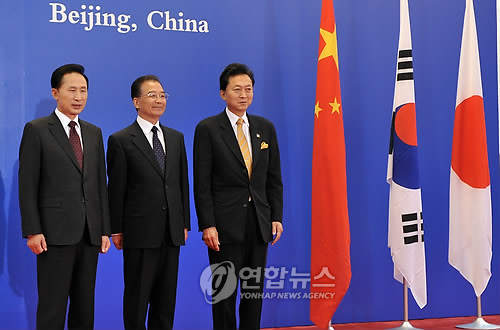
We hope the fifth trilateral summit will enhance cooperation between the three East Asian countries, and lead to a improved security, business, and trade, and deter North Korea's provocations and nuclear test that will bring hell to world peace.
Sunday, May 13, 2012
S. Korea, China, Japan agree to launch free trade talks this year
.jpg)


South Korea, China and Japan agreed Sunday to launch official negotiations this year to forge an ambitious pact tearing down barriers to trade between the three of Asia's biggest economies.
South Korean President Lee Myung-bak, Chinese Premier Wen Jiabao and Japanese Prime Minister Yoshihiko Noda reached the agreement during annual summit talks in Beijing that also covered North Korea and other issues of cooperation.
The envisioned pact, if realized, would create one of the world's largest markets as South Korea, China and Japan account for 20 percent of the global gross domestic product (GDP), 17.5 percent of all global trade, and 22 percent of the global population.
Such a deal could also help improve overall relations between the three countries, which have often frayed over their shared history, including Japan's aggression against the other nations in the early 20th century.
But widespread views are that negotiations would be tough and lengthy.
"I believe the launch of FTA negotiations this year is very meaningful for the future of cooperation between the three countries," Lee said during a joint news conference after the summit talks.
During a meeting with business leader of the three countries, Lee also said that an FTA between the three neighbors could significantly contribute to the world economy and global free trade efforts.
On the sidelines of the summit, the three countries also signed an investment guarantee treaty that calls for providing most-favored-nation status and other protective measures for investment from each other.
The pact is the first economic treaty between the three countries.
North Korea was high on the agenda for the summit.
Sunday's talks came a month after Pyongyang's long-range rocket on April 13. Though the rocket fizzled soon after takeoff, the liftoff drew international condemnation as it broke a U.N. ban adopted over concerns such a launch could be used to develop missiles capable of carrying nuclear warheads.
Concerns have since grown that Pyongyang could stage additional provocations, such as a nuclear test, which would be its third, as well as more missile tests and border clashes. Officials in Seoul have said the North appears to have completed preparations for a nuclear test.
They exchanged views on the launch of North Korea's new leadership, its long-range rocket launch and related developments.
Lee also said he proposed during the summit that the three countries should cooperate closely to study "more effective" and fresh measures to deter North Korean provocations. Lee did not elaborate.
But Chinese Premier Wen spoke in a softer tone during the news conference, calling for all sides to "abandon Cold War-style thinking" so as to resolve tensions and stressing the "most urgent issue for now is to prevent tensions on the Korean Peninsula."
During the summit talks behind closed doors, however, Wen said that China has been strongly urging Pyongyang to refrain from additional provocations since last month's rocket launch, according to Kim Tae-hyo, a senior security aide to President Lee.
China is usually reluctant to openly criticize North Korea. Beijing is the North's last-remaining major ally that provides the isolated nation with crucial economic aid and diplomatic support. Experts say China dreads any instability in North Korea as it could hurt its economic and political interests.
The three countries also signed two other cooperation agreements, one of them on agricultural cooperation and the other on preventing desertification of forests and protecting wildlife.
Later in the day, Lee held one-on-one summits with Wen and Noda.
South Korea, China and Japan have held an annual three-way summit since 1999 on the sidelines of regional summits organized by the Association of Southeast Asian Nations (ASEAN). Since 2008, the sides have also held another regular summit that rotates among the three countries, and Sunday's meeting was the fifth.
Monday, May 7, 2012
S.Korea's trade with China lags far behind Japan
South Korea's trade with China lagged behind Japan in the first quarter of this year due to fierce competition from a rival exporting country in the world's most populous market, a Chinese government report showed Tuesday.
Trade between South Korea and China reached US$60.3 billion in the January-March period, compared with Tokyo's trade volume of $79.4 billion with Beijing, according to the report by the Chinese Ministry of Commerce.
Taiwan, the majority of whose exports overlap with the South Korean exports, saw its trade with China reach $35.1 billion in the same period.
The data, however, did not show the respective figures for imports and exports.
South Korea, Japan and Taiwan have been closely competing in China, especially in the categories of electronics, technology products and parts.
For all of 2011, South Korea's exports to China were worth $162.7 billion, while its imports were worth $82.9 billion.
Japan exported to China $194.6 billion worth products and services, with its imports from China reaching $148.3 billion.
Taiwan recorded $124.9 billion in exports last year and $35.1 billion in imports.
Source : Yonhap News Agency
Subscribe to:
Posts (Atom)