North Korea has issued a catalog of alarming threats against the South and the United States in the past several weeks, sharpening its rhetoric after the U.N. Security Council imposed stricter sanctions for Pyongyang's latest underground nuclear test, which took place it February. North's unnerving behavior is an effort by Kim, who inherited power from his father less than a year and a half ago, to shore up domestic support, particularly with the military. Pyongyang is trying to secure direct negotiations with Washington, something the United States has long shunned in favor of multilateral talks. However, the North Korean regime's recent words and actions appear to be increasingly troubling its key ally, China.
Tuesday, April 9, 2013


Monday, April 8, 2013
North Korea takes but does not give
On Sept 19, 2005 the six-party talks drafted a peaceful resolution regarding the security concerns as a result of the North Korean nuclear weapons program. North Korea had agreed to shut down its nuclear facilities in exchange for aid and stepped towards the normalization of relations with the US. However, responding angrily to the UN Security Council’s Presidential Statement that condemned t he North Korean failed satellite launch, they declared that it would pull out of Six Party Talks and that it would resume its nuclear enrichment program in order to boost its nuclear deterrent. North Korea has also expelled all nuclear inspectors from the country. Over the past 20 years, North Korea has persistently made empty promises. Kim Jong-un has told that he is open to talks with the US and that he is awaiting Obama’s call. However, if North Korea does not stop their nuclear threats, there will be no talks or aids.
(http://www.acronym.org.uk/official-and-govt-documents/joint-statement-north-koreas-nuclear-programme)
Sunday, April 7, 2013
Is North Korea on the brink of war?

The US will deploy a missile- defense system to Guam in coming weeks as a “precautionary move” against North Korea’s ballistic missile threat. This deployment will strengthen defense capabilities for American citizens in the U.S. territory of Guam and U.S. forces stationed there.
The Terminal High-Altitude Area Defense program, or Thaad, that is being deployed is a land-based system made by Lockheed Martin Corp. (LMT) that uses truck-mounted launchers to intercept missiles. The decision to send it to Guam is the latest U.S. military response to North Korea’s heightened rhetoric. Two Navy destroyers were deployed to the western Pacific this week. The United States continues to urge the North Korean leadership to cease provocative threats and choose the path of peace by complying with its international obligations. US stated that North Korea presents a “real and clear danger” to the U.S. and allies in the region. The U.S. is taking the threat seriously and is engaged in joint exercises with South Korea as well as working with China to ask its help in defusing the situation.
(http://qz.com/70650/meet-thaad-the-bloated-defense-project-that-might-protect-guam-from-a-north-korean-missile-strike/)
Thursday, April 4, 2013
North Korea attacking the US?
Even by its own aggressive standards, North Korea’s actions over the past couple of weeks have been extraordinary. Kim Jong-un, the country’s young dictator, has threatened the US with nuclear Armageddon, promising to rain missiles on mainland America and military bases in Hawaii and Guam, and declared a “state of war” with South Korea. Kim Jong-un announced that he would restart a plutonium-producing reactor at its Yongbyon nuclear site, while enriching uranium to build more nuclear weapons, and barred South Korean managers from entering the Kaesong industrial complex, almost the only instance of North-South co-operation. All this comes after the regime set off a nuclear test, its third, in February. Tensions are the worst on the peninsula since 1994, when North Korea and America were a hair’s breadth from war. The US has tried to play down the aggression, talking of a “disconnect between rhetoric and action”, and some parts are pure bluster. The nuclear threat against mainland America is patently hollow. It will be years before the North has the technology to dispatch nuclear-tipped missiles. In response to North Korea’s dire threats, the US deployed of B-2 stealth bombers and F-22 fighters. Now more than ever, America needs to cajole China to press for change in its satellite. Apart from humanitarian aid to the North’s stunted people, all other commercial favours towards the regime should be stopped. Sick of Mr Kim and his family racket, China signed up to fresh UN financial sanctions against North Korea after the latest nuclear test. China has the capacity to choke the most iniquitous sources of the criminal regime’s cash.
(http://www.nytimes.com/2013/04/05/world/asia/north-korean-missile-moved-to-coast.html?_r=0)
Wednesday, April 3, 2013
China expresses regret at North Korea restarting nuclear plant

China's Foreign Ministry expressed regret that North Korea will restart all nuclear facilities, including its shuttered Yongbyon nuclear reactor. Tensions on the peninsula have soared in recent days, with Pyongyang on Friday ordering missile units to standby, hours after nuclear-capable US B-2 stealth bombers were deployed in US joint military drills with South Korea. North Korea has said it will reopen its nuclear facilities amid war rhetoric against South Korea and United States. North Korea believes that if it possesses nuclear weapons, all their problems would be solved. They are very wrong. North Korea develops nuclear weapons, all the neighboring countries would develop nuclear weapons in reaction. Ultimately, everybody would have nuclear weapons, and North Korea would lose its asymmetric advantage. Then, North Korea would have nothing to leverage their positions.
(http://zeenews.india.com/news/world/china-regrets-north-korea-s-threat-to-reopen-nuke-plant_839262.html)
Tuesday, April 2, 2013
North Korea Is Not Even Close To Hitting The US With A Nuke
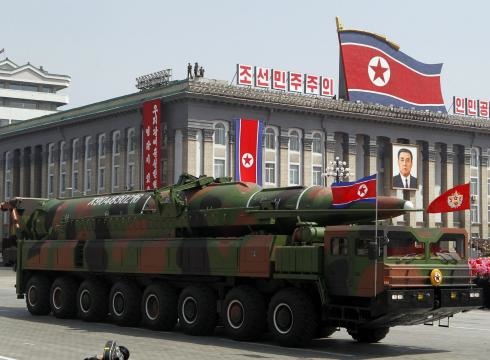
As North Korea continues to talk of war against their neighbor to the south, they've also started to threaten the United States, saying that "thermonuclear war" may be on the horizon. Reality, yet again, is not on the side of Pyongyang. The North Koreans still need a few things - a reliable long range, intercontinental ballistic missile (ICBM), a nuclear warhead built to fit that missile, and the technology that can guide it through launch, reentry, and hitting the target North Korea has test fired a number of missiles with varying ranges. They've been successful with some short and medium range platforms, but their long range capabilities have been marked with many failures.
These include its Taepodong-1 rocket launch in 1998, which failed to reach orbit, and its Taepodong-2 in 2006, which ended up exploding only 40 seconds after takeoff. They are slowly progressing though, with a new system (they claim is only for launching satellites) called Unha-3 boasting a range of approximately 6,000 miles (Pyongyang to San Francisco is about 5,600). The US is fully capable of defending against any North Korean ballistic missile attack North Korea certainly has the capability of hitting their regional neighbors — Japan, Guam, and South Korea — but a defiant Kim Jong-Un claiming he's ready to launch nukes at the United States, is nothing but talk — and everyone knows it.
(http://openchannel.nbcnews.com/_news/2013/03/07/17225444-north-korea-threat-of-nuclear-attack-predictable-but-worrisome?lite)
Monday, April 1, 2013
North Korea is incapable for a full-scale war!

The U.S. Navy is shifting a guided-missile destroyer in the Pacific to waters off the Korean peninsula in the wake of ongoing rhetoric from North Korea. The USS McCain is capable of intercepting and destroying a missile, should North Korea decide to fire one off. Still, there is nothing to indicate that North Korea is on the verge of another launch. I would note that despite the harsh rhetoric we are hearing from Pyongyang, there are no changes to the North Korean military posture, such as large-scale mobilization and positioning of forces. The deployment came after the United States publicized a rare training flight by two B-2 bombers over South Korea, where they carried out a mock bombing run, and pledged to spend $1 billion to expand ballistic missile-defense systems along the Pacific Coast. On Sunday, The United States sent F-22 stealth fighter jets to South Korea as part of military exercises in a move aimed at further deterring threats from North Korea against its neighbor. If North Korea continues their threats, the international community will only reinforce sanctions. North Korea cannot take on the whole world. It should learn to give in.
Subscribe to:
Posts (Atom)